
 Orthopedics
Spinal Surgery in the UAE.
Pricing for Spinal Surgery depends on your insurance, so there's no single price to compare. See the hospitals and specialists who offer it below.
Coverage & insurance
Coverage for Spinal Surgery
Pricing for Spinal Surgery depends on your insurance: see hospitals and specialists who offer it.



View all 16 clinics









- Procedure type
- A family of operations, decompression, fusion and disc surgery
- Admission
- Inpatient، the stay depends on the operation and number of levels
- Performed by
- Orthopaedic spine surgeons and neurosurgeons
- Typical insurance position
- Covered with criteria، approval usually needs matching MRI findings
What spinal surgery covers
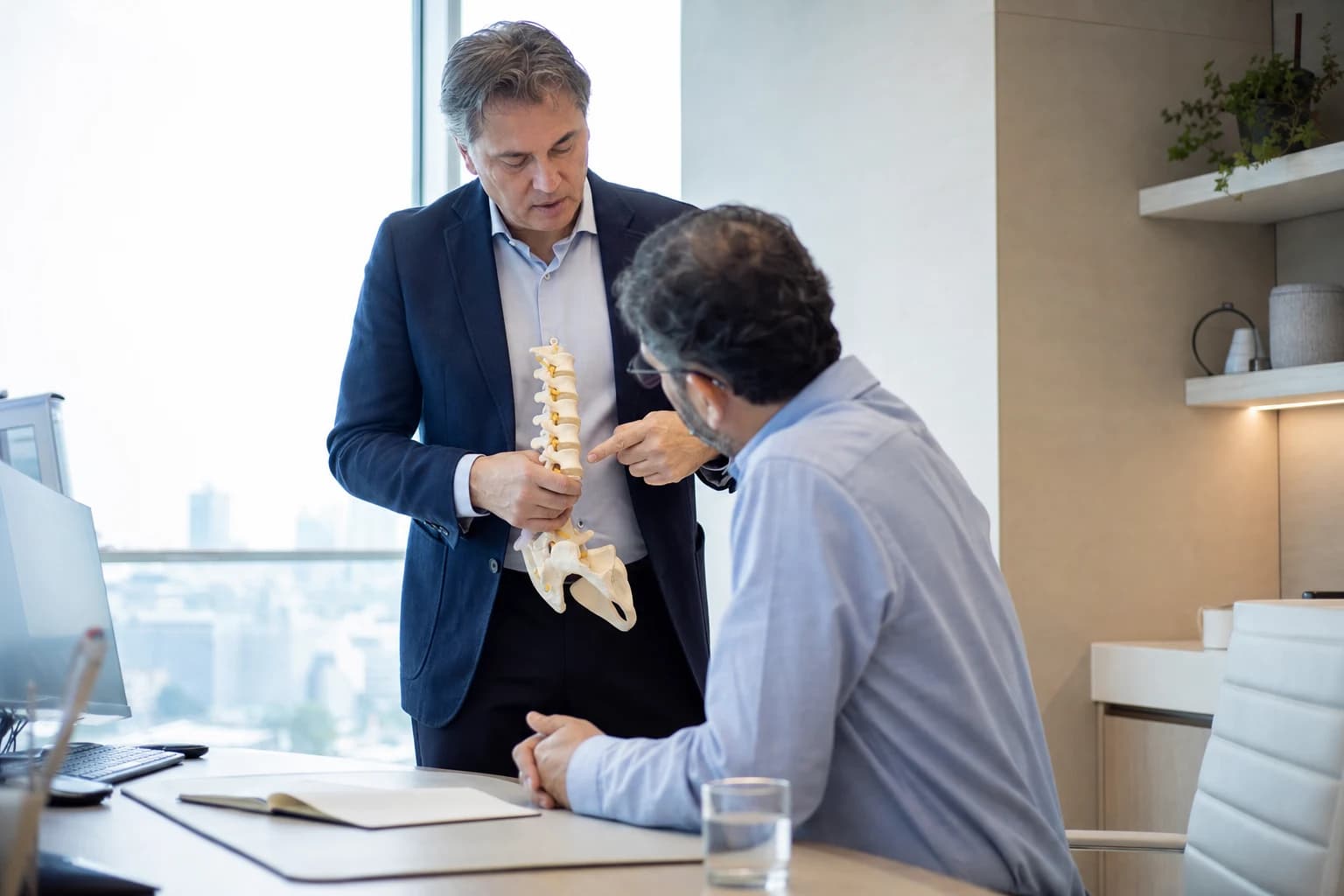
Spinal surgery is a family of operations, not one procedure. The most common in the UAE are decompressions (a microdiscectomy to remove the part of a disc pressing on a nerve, or a laminectomy to widen a narrowed spinal canal) and fusions, which join two or more vertebrae with implants to stabilise a segment. Some are done through small incisions with an endoscope or a microscope; others are open. They are performed by orthopaedic spine surgeons and by neurosurgeons, and both routes are legitimate. The single most important thing to understand is that surgery treats a structural problem compressing a nerve or destabilising the spine. It is not a general treatment for back pain, and most back pain in the UAE never needs an operation at all.
Why there is no price to compare
Insurance pays for spinal surgery in most UAE cases, so hospitals publish nothing, and even if they did, one price for "spinal surgery" would be meaningless. A single-level microdiscectomy and a multi-level fusion with instrumentation differ in theatre time, implants, inpatient stay and rehabilitation by a wide margin. This page therefore compares what can honestly be compared: which hospitals perform spinal surgery, which insurance networks they sit in, and which licensed spine surgeons and neurosurgeons practise there. If you are self-paying, insist the quote names the operation, the number of levels and the implant cost separately, and ask what happens financially if the surgeon finds they need to treat an additional level.
Insurance and coverage
Comprehensive UAE plans generally cover spinal surgery when it is medically necessary and approved in advance, but insurers examine these requests more closely than most. The usual requirements are MRI findings that correlate with your symptoms (imaging alone is not enough, because disc changes are common in people with no pain at all) and a documented trial of conservative treatment such as physiotherapy, medication or injections. Fusion attracts more questions than decompression, and a request may be queried or partially approved rather than refused outright. Your network tier decides which hospitals you can use, and co-payments, annual limits and pre-existing-condition waiting periods still apply. Emergency presentations with progressive weakness, loss of bladder or bowel control or severe neurological signs follow an urgent pathway and should go straight to an emergency department rather than through a planned approval process.
What to expect
The pathway usually starts with a specialist consultation, an MRI and sometimes nerve conduction studies, followed by a period of conservative treatment unless there are red-flag symptoms. If surgery is agreed, a pre-operative work-up runs alongside the insurance approval. What happens next depends on the operation: a microdiscectomy is a relatively short procedure with a short inpatient stay and a return to light activity within weeks, while a multi-level fusion is a longer operation with a longer stay and a rehabilitation programme measured in months. Nerve pain radiating down a leg or arm often improves faster than back pain itself, which is worth knowing so your expectations match what the operation is designed to do. Recovery varies between individuals, ask your surgeon for the timeline for your specific operation.
Risks, and when surgery is not the answer
Spinal surgery carries risks including infection, bleeding, blood clots, dural tears, nerve injury, failure of a fusion to unite, and the possibility that pain persists or returns. The most important safeguard is patient selection: surgery works most reliably where a clear structural problem on imaging matches the pattern of symptoms. Disc changes are extremely common on MRI in people with no symptoms at all, so a scan finding on its own is not a reason to operate. For most back pain without nerve compression or red flags, conservative treatment is the appropriate first course, and international guidance supports that. If an operation is proposed for back pain alone, it is reasonable to ask what structural problem it addresses, what improvement is expected, and what happens if it does not work, and to seek a second opinion. Red-flag symptoms are the exception: progressive weakness, numbness in the saddle area or loss of bladder or bowel control need urgent assessment, not a second opinion appointment next month.
Choosing a hospital and a surgeon
Start with your insurance network, then focus on the surgeon. Spine surgery is performed by both orthopaedic spine surgeons and neurosurgeons; what matters is how much spine work they do and of what type, not which of the two training routes they came from. Check the licence on the regulator’s register. Ask what operation is proposed and at how many levels, what the alternatives are including continued conservative treatment, what improvement is realistically expected and in which symptom, who provides the rehabilitation afterwards, and what the plan is if the pain persists. A surgeon who is comfortable discussing the limits of the operation is giving you better information than one who is not. Facility licence status shown on this site is a licensing check against the regulator’s available records, and not an endorsement of clinical quality or outcomes.
Frequently asked questions
Why does this page not show spinal surgery prices?
UAE hospitals do not publish them, because insurance pays in most cases. A single price would also be misleading: spinal surgery covers operations that differ enormously in length, implants and recovery. We show which hospitals perform it and which insurance networks they belong to instead of inventing a range.
Is spinal surgery covered by insurance in the UAE?
Generally yes when it is medically necessary and approved in advance, but insurers scrutinise these requests closely. They typically want MRI findings that match your symptoms and a documented trial of conservative treatment first. Fusion attracts more questions than decompression. Confirm the approval route with your insurer before a date is set.
Do I have to try physiotherapy before surgery is approved?
In most planned cases, yes. Insurers commonly expect a documented record of conservative treatment (physiotherapy, medication or injections) before approving surgery. It is a clinical expectation as well as an administrative one. Ask your surgeon early what documentation the insurer will want, because missing records delay approvals.
My MRI shows a disc problem. Does that mean I need surgery?
Not on its own. Disc changes show up on MRI in a large share of people who have no pain at all, so a scan finding only matters when it explains your specific symptoms. Surgery is considered where the imaging and the symptoms match, and usually after conservative treatment has been tried.
What is the difference between a decompression and a fusion?
A decompression removes what is pressing on a nerve, part of a disc or bone narrowing the canal. A fusion joins vertebrae together with implants to stabilise a segment that is moving abnormally. Fusion is the larger operation with the longer recovery, and insurers generally question it more closely.
Should I see an orthopaedic surgeon or a neurosurgeon?
Both perform spinal surgery in the UAE and both routes are legitimate. What matters more is how much spine work the individual surgeon does and of what type. Check the licence on the regulator’s register and ask about their volume in the specific operation being proposed.
How long is the recovery?
It depends on the operation. A single-level microdiscectomy typically involves a short stay and a return to light activity within weeks. A multi-level fusion involves a longer stay and a rehabilitation programme measured in months. Ask for the timeline for your specific procedure rather than for spinal surgery in general.
When is back pain an emergency?
Progressive weakness in a leg or arm, numbness around the groin or saddle area, or loss of bladder or bowel control need urgent assessment at an emergency department, not a clinic appointment. Severe pain after significant trauma, or back pain with fever, also warrants urgent review.
Prices are collected from each provider’s own published pages. They are indicative and subject to change. Confirm the final price and what it covers with the provider. Facility licence status is checked against the regulator’s available records; that is not an endorsement of clinical quality or outcomes. This is general information, not medical advice.