
 Gastroenterology
Endoscopy
Endoscopy & Colonoscopy Package
Saudi German Hospital – Al Tallah Region · Al Tallah, AjmanGoogle Reviews4.2★(6,621)
7 testsDoctor consultationIn-clinic
Compare 1 Endoscopy package across the UAE. Prices from AED 3,700 to AED 3,700.
Showing 1 of 1 tests & packages with confirmed prices & contents
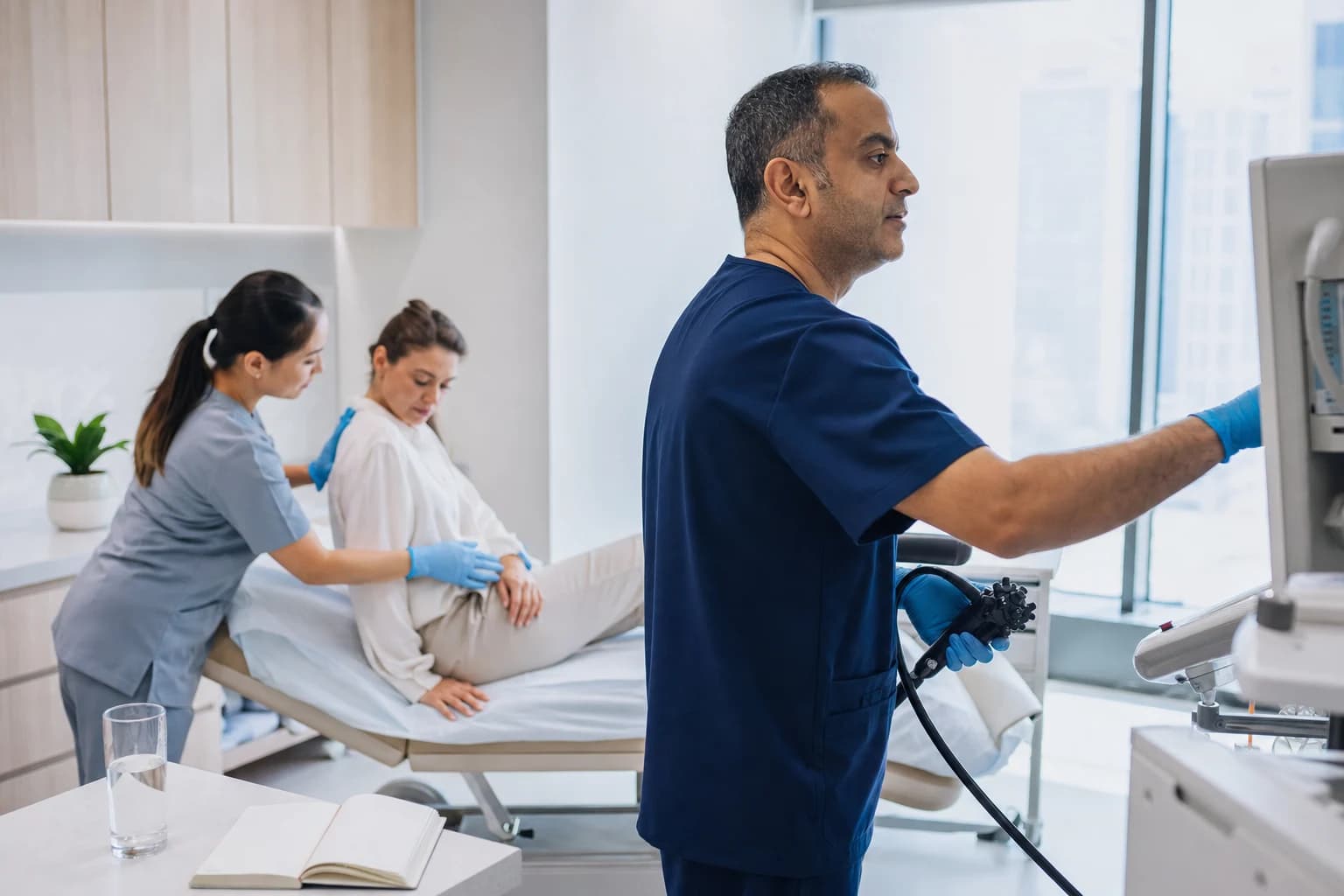
An upper endoscopy, usually called a gastroscopy, examines the oesophagus, the stomach and the first part of the small intestine using a thin flexible camera passed through the mouth. It is a day-case procedure and the examination itself commonly takes ten to twenty minutes. It is used to investigate persistent reflux or heartburn, difficulty or pain on swallowing, upper abdominal pain, vomiting, unexplained anaemia and weight loss. Like a colonoscopy, it can both look and act: biopsies can be taken, Helicobacter pylori can be tested for, a narrowing can be stretched and a bleeding point can be treated in the same sitting.
A gastroscopy is one of the less expensive endoscopic procedures, but the quote is rarely the whole bill. Sedation is the first variable: some patients have only a numbing throat spray while others have intravenous sedation with an anaesthetist, and those are different costs. The day-case facility fee may be separate. Pathology is the item that moves the total most, because biopsies are common and each specimen is charged. Testing for Helicobacter pylori may be an extra line. If your doctor has recommended a gastroscopy and a colonoscopy, ask about doing both in one session, which usually costs less than two separate appointments and means one preparation and one sedation. Where providers on this page publish verified prices, they appear above.
A gastroscopy done to investigate symptoms is generally covered with prior approval. The point that catches people out is that insurers commonly want to see that straightforward reflux was treated medically first, so a request submitted without that history can be queried or delayed rather than refused. Warning features such as difficulty swallowing, vomiting, anaemia or weight loss change that calculation and usually justify earlier endoscopy, so make sure your referral states them if they apply. Because the procedure is a day case, it may draw on a different benefit and limit than inpatient care, and biopsy pathology may sit under a laboratory benefit. An endoscopy bought as part of a health package with no symptoms is usually a wellness purchase rather than a covered investigation.
Preparation is simple compared with a colonoscopy: you fast for several hours beforehand so the stomach is empty, and you will be told when to stop food and fluids. Tell the team in advance about blood thinners and diabetes medication, since these often need adjusting. In the room you lie on your left side, a mouthguard protects your teeth, and either a numbing throat spray or intravenous sedation is given. The scope is passed through the mouth; it does not interfere with breathing, though gagging at the start is common and the sedation is there to make it manageable. It is usually over in ten to twenty minutes. If you had sedation you will rest until it wears off, need someone to take you home, and should not drive that day. A mildly sore throat afterwards is normal.
Gastroscopy is a common procedure with a good safety record. Serious complications are uncommon and include bleeding, particularly after a biopsy or a therapeutic step, and perforation, which is rare but serious. Sedation carries its own small risks, more so in older patients and those with heart or lung disease, so tell the team about your medical history. The more practical question is whether you need the test at all: uncomplicated reflux is usually treated medically first, and endoscopy is reserved for symptoms that persist despite treatment or for warning features such as difficulty swallowing, vomiting, anaemia, weight loss or a family history of upper gastrointestinal cancer. Those warning features should be assessed promptly rather than managed with over-the-counter remedies.
Check your network, then ask the practical questions: who performs the procedure and what their licence and volume are, what form of sedation is offered and whether an anaesthetist is involved, and whether sedation and the facility fee are inside the quote. Ask what happens if biopsies are taken, both in cost and in how and when you get the result. Ask whether the unit is attached to a hospital in case escalation is needed. If a colonoscopy is also planned, ask whether both can be done in one session. Facility licence status shown on this site is checked against the regulator’s available records. That is a licensing check, not an endorsement of clinical quality or outcomes, and not a verification of any price.
No. An upper endoscopy, or gastroscopy, examines the oesophagus, stomach and the first part of the small intestine through the mouth. A colonoscopy examines the large bowel from the other end and needs full bowel preparation. They are separate procedures, though they are sometimes done in the same session.
You may have a numbing throat spray only, or intravenous sedation. With sedation you will need someone to take you home, you should not drive that day, and most people do not go back to work. With spray alone many people carry on as normal. Ask which is planned when you book.
The examination itself commonly takes ten to twenty minutes. Allow longer for admission, sedation and recovery, so plan for a few hours at the unit rather than a quick appointment, particularly if you are having intravenous sedation.
For uncomplicated reflux, treatment is normally tried before endoscopy, and insurers commonly expect that history in the approval request. Warning features such as difficulty swallowing, vomiting, anaemia or weight loss change this, so make sure your referral states them if they apply to you.
Biopsies are small tissue samples used to confirm conditions such as coeliac disease, inflammation or Helicobacter pylori infection, and to check anything that looks unusual. Pathology is charged per specimen in most UAE providers, so taking biopsies adds to the bill. Ask what that adds before the procedure.
Often yes, and it is usually the sensible option if both are indicated. One admission, one sedation and one recovery, and the combined price is generally lower than two separate appointments. The bowel preparation for the colonoscopy still applies. Ask your provider whether they offer it.
Prices are collected from each provider’s own published pages. They are indicative and subject to change. Confirm the final price and what it covers with the provider. Facility licence status is checked against the regulator’s available records; that is not an endorsement of clinical quality or outcomes. This is general information, not medical advice.